
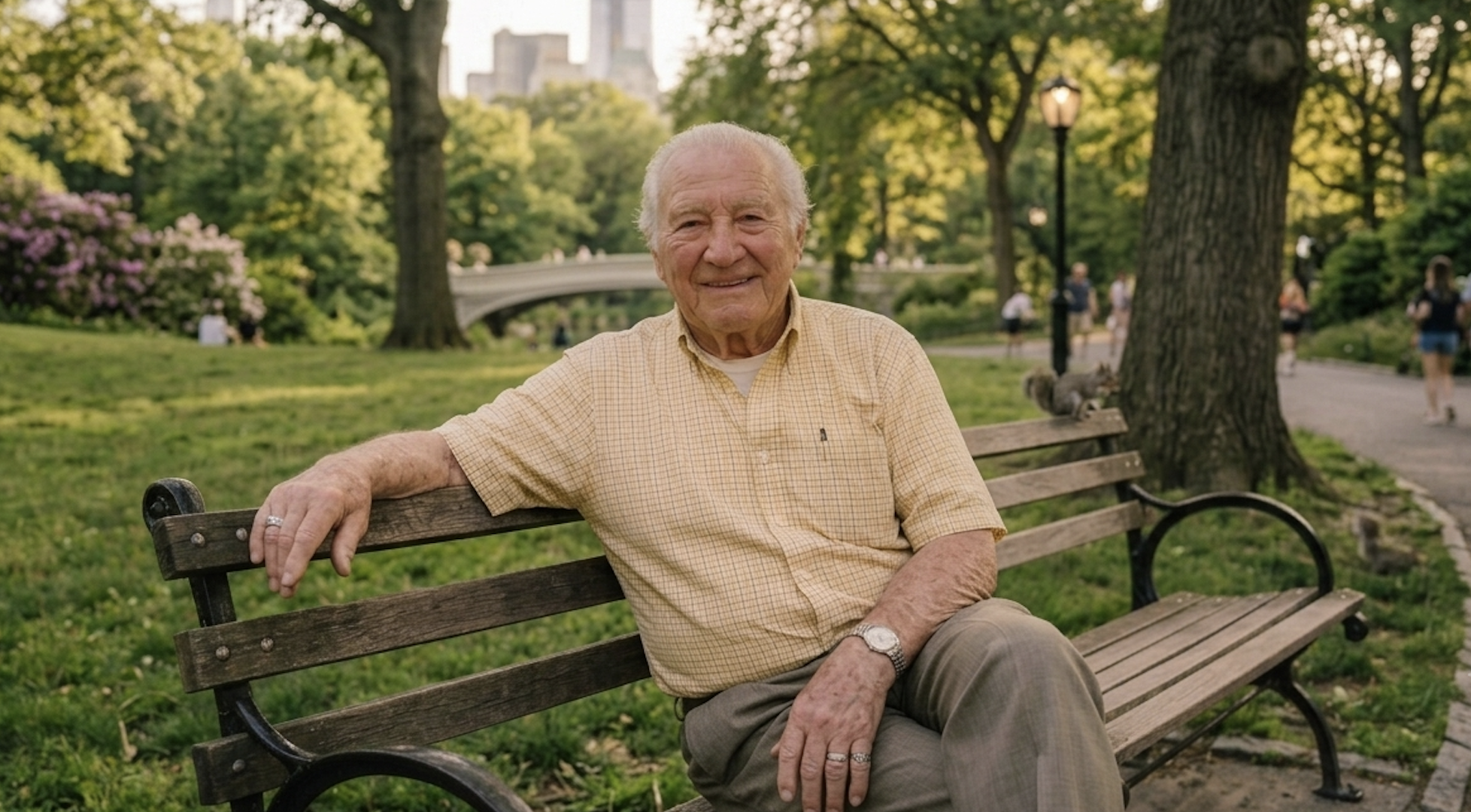
The healthiest-looking person in any room is not necessarily the healthiest person in the room.
We all know this. We don't act like it.
We read health through visible signals. Weight. Posture. Energy. Whether someone ran a half-marathon last spring. We have built an entire instinct for "who looks at risk" - and that instinct is almost entirely useless for what actually matters.
Because health risk doesn't look like anything. It has a direction - one that's been moving, quietly, in the bloodwork, for years before anyone thinks to look.
The gap nobody talks about
40 million Americans have diabetes. One in four don't know it. Almost half of US adults have hypertension, and roughly one in four of them does not know it. Nine in ten adults with early kidney disease are completely unaware.
These are not obscure conditions. They are among the most common chronic diseases in the world - and in every case, the standard of care catches them late. Often years after the data has been signalling something.
Insulin resistance is detectable 10 to 15 years before a type 2 diabetes diagnosis. Bone density is largely set before your 18th birthday, but most women don't measure it until they're in their fifties. ApoB can climb quietly for a decade before anyone calls it a problem.
None of this shows up in how someone looks at dinner. All of it shows up in the data - if anyone bothers to track it over time.
Detection is not prevention
The question worth asking is not "why don't people see a doctor more." Most people with undetected chronic conditions have seen a doctor recently. The problem is what happens when they get there.
A standard check-up produces a snapshot. A single result, evaluated against a reference range, compared to nothing. If the number sits inside the range, the conversation ends. The fact that it sat 40 percent lower two years ago - that it has been moving steadily in one direction - is information that exists nowhere in that room, because nobody assembled it.
We have confused a single measurement with a record. They are not the same thing.
Detection is reactive. You feel something, you go, you test, you find out. That is not prevention. That is catching a problem at the moment it has already been building for years.
Prevention is the glucose trend you track for three years and correct before it has a name. It requires data that doesn't exist from a single visit. It requires a sequence.
The fragmentation problem
Only 7 percent can combine them. Your health story - the most important longitudinal dataset about you that exists - lives in fragments. A GP who sees you in 2024 has no visibility of what the specialist found in 2019. Every encounter is a first encounter. Every result is evaluated in isolation.
This is not a failure of care. It is a failure of infrastructure.
What prevention actually requires
You cannot prevent what you cannot see coming. And you cannot see direction from a single point.
The gap between detection and prevention is a data infrastructure problem. Not a motivation problem. Not an access problem. The data exists. Since the 21st Century Cures Act and TEFCA - now connecting over 71,000 organisations - it is legally yours and technically retrievable.
The missing piece is the layer that turns scattered fragments into a coherent sequence. One timeline. Every result. The trend always visible. The comparison to six months ago and two years ago always one tap away.
You can't see risk. You can only track it.
That is the only gap worth closing.
One Timeline. Every Result.
